

Not entirely—AI automates many tasks, but human oversight is still essential for strategy, exceptions, and complex decisions.
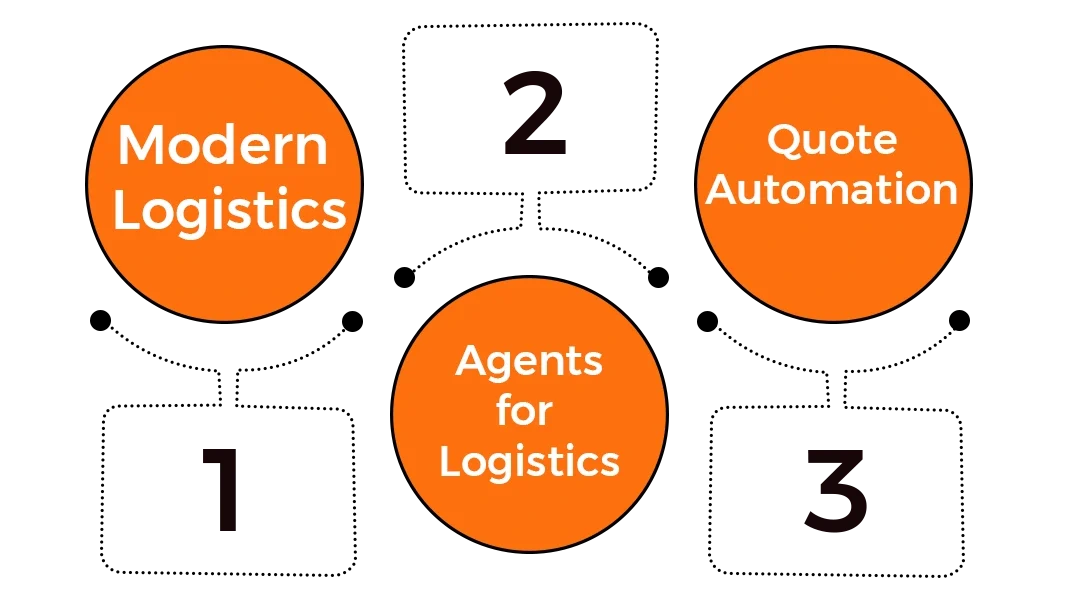
Key Capabilities of AI Agents in Logistics
01
Real-Time Quote Automation
Manual quoting can delay service commitments and frustrate clients. AI agents extract customer data, populate CRM systems, and generate quotes in seconds.
- Improve response time by up to 80%
- Enhance accuracy, reducing pricing errors
- Deliver quotes through omnichannel platforms like email, chatbots, or web portals
Quote automation also ensures better customer retention by providing a smooth, frictionless experience.
02
Inventory Optimization and Demand Forecasting
AI agents monitor stock levels, analyze historical sales trends, and predict future demand.
- Prevent overstocking and stockouts
- Lower holding costs
- Ensure product availability during peak demand
Predictive analytics help businesses better align inventory with sales forecasts and seasonal demand patterns.
03
Route and Delivery Optimization
AI agents use live data—such as traffic updates, weather patterns, and vehicle locations—to map the most efficient delivery routes.
- Cut transportation costs
- Reduce fuel consumption
- Improve on-time delivery rates
Advanced algorithms ensure dynamic rerouting in case of unexpected disruptions, increasing supply chain resilience.
Why Businesses Need AI Agents for Logistics
Implementing AI agents in supply chain and logistics operations goes beyond simple process improvements—it offers strategic benefits that shape long-term success.
Enhanced Customer Experience
AI agents improve communication, automate responses, and deliver real-time updates on orders or delivery status.
- Personalized support via AI-powered chatbots
- 24/7 availability across customer service channels
- Increased satisfaction and loyalty through consistent service
Your customers demand speed and transparency—AI enables both.
Reduced Operational Costs
By automating tasks traditionally handled by human workers, AI agents lower labor costs and eliminate inefficiencies.
- Reduce manual data entry
- Minimize errors in shipment or inventory tracking
- Cut unnecessary delays in procurement cycles
AI enables leaner, more cost-effective operations without sacrificing quality.
Strategic Decision-Making
AI agents process complex data from diverse sources, providing actionable insights to leaders.
- Identify supply chain bottlenecks
- Analyze supplier performance
- Monitor KPIs like inventory turnover and delivery timelines
Executives and logistics managers gain real-time dashboards to make proactive, rather than reactive, decisions.
How Our AI Agents for Logistics Outperform the Competition

Use Cases Across the Logistics Ecosystem
01.
Warehouse Automation
From intelligent picking and packing to space utilization and cycle counting, AI agents streamline warehouse workflows. Integration with IoT devices and robotics ensures real-time execution of tasks without human intervention.
02.
Supplier Management
AI agents analyze contract compliance, delivery timelines, and quality metrics. They alert managers to underperforming vendors and recommend more reliable suppliers, supporting procurement optimization and cost savings.
03.
Predictive Maintenance
Vehicle and equipment breakdowns can grind logistics operations to a halt. AI agents detect wear-and-tear patterns, monitor telemetry data, and schedule maintenance before failure occurs, keeping fleets on the road.

Transform Your Operations with Smart Logistics AI
Locations We Serve
Charlotte | New York City | Austin, Texas | Atlanta | Dallas | Boston | Seattle | Washington DC | California | Florida | Toronto | Latin America | Singapore | Sydney | Switzerland
Our Customers








Testimonials
Trusted by innovators worldwide
FAQs About AI Agents in Logistics
AI improves logistics by automating route planning, inventory tracking, demand forecasting, and quote generation for faster, smarter operations.
They are Simple Reflex, Model-Based Reflex, Goal-Based, Utility-Based, and Learning Agents—each with increasing complexity and decision-making ability.
Top options include LeewayHertz, Bridgnext, Blue Yonder, and Amazon SageMaker—depending on your logistics needs and tech stack.
AI implementation in logistics faces challenges like high initial costs, data quality issues, integration with legacy systems, and the need for skilled personnel to manage and fine-tune the algorithms.
Discuss Your Logistics Automation Goals
Looking for a custom solution? Email us at [email protected] or fill out the form below. We’ll get back to you within 24 hours.
[email protected]
12300 Ford Rd, Ste 290, Dallas, TX 75234